Patterns Beneath the Surface
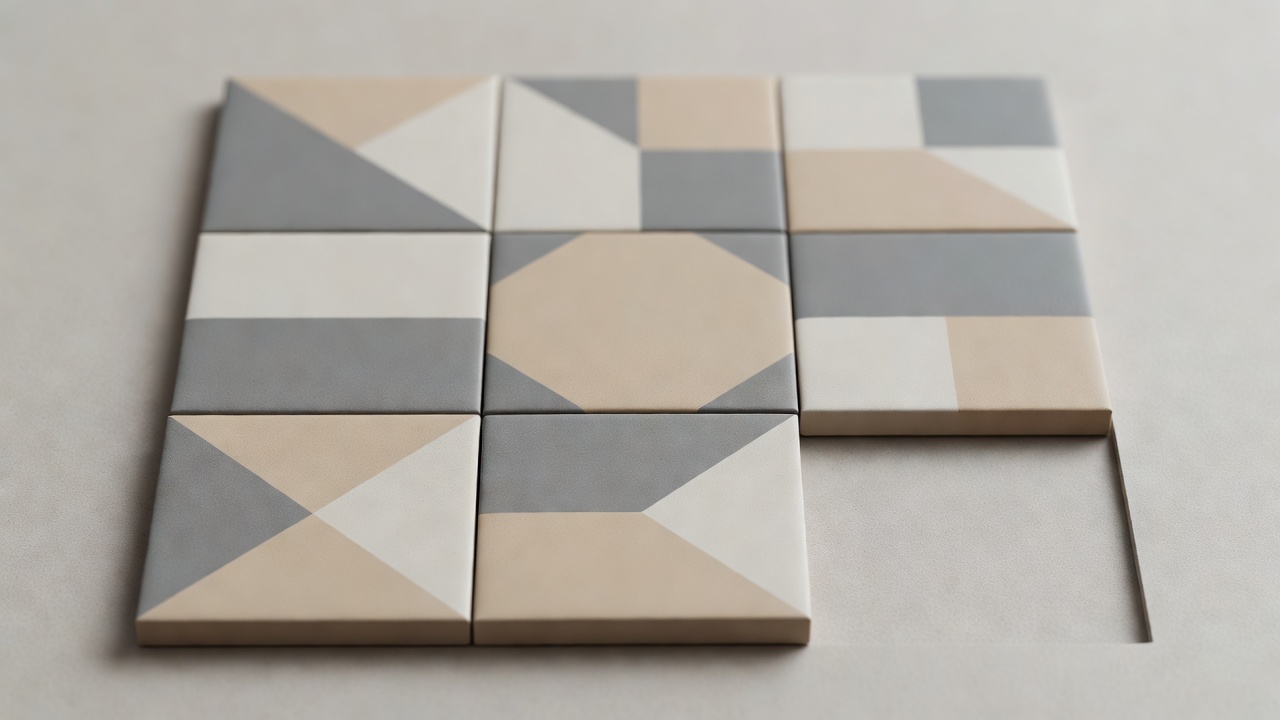
When solving a visual or structural pattern puzzle, the eye naturally tries to take in the entire figure at once. Yet complex patterns are almost never governed by a single holistic impression; they are built by layering two or three simple, independent rules on top of one another. Whether examining a 3×3 transformation grid (first systematized by John C. Raven in 1936) or a six-against-six contrast diagram created by Soviet cyberneticist Mikhail Bongard in his 1967 book Pattern Recognition, the reliable approach is attribute decomposition: isolate one visual feature at a time and track its behavior across rows and columns.
1. The Four Canonical 3×3 Matrix Grammars
In a standard nine-cell matrix where the bottom-right cell (Row 3, Column 3) is missing, nearly all deterministic challenges use one or a combination of four grammatical rules:
| Matrix Rule Type | How It Operates Across a Row/Column | Diagnostic Clue |
|---|---|---|
| 1. Constant Distribution (Latin Square) | Each row and column contains exactly one instance of three possible states (e.g., Circle, Square, Triangle). | Every symbol appears three times in the full grid, regardless of order. |
| 2. Kinematic Progression | An element rotates by a fixed angle (e.g., 90° clockwise) or increments its count (+1 line segment) per step. | The middle cell sits halfway between the left and right cells in orientation or quantity. |
| 3. Boolean Overlay (AND / OR / XOR) | Cell 1 and Cell 2 are superimposed to form Cell 3. In XOR (exclusive-or), overlapping lines cancel out and disappear. | Cell 3 contains segments from Cell 1 and Cell 2, but shared borders vanish. |
| 4. Conservation of Quantity | The total number of dots, intersections, or enclosed regions sums to a constant value across every row. | Shapes vary wildly, yet counting vertices or closed loops yields 12 in Row 1 and 12 in Row 2. |
2. Bongard Problems: Finding the Dividing Boundary
In 1967, Mikhail Bongard published 100 visual puzzles later celebrated by Douglas Hofstadter in Gödel, Escher, Bach (1979). A Bongard problem presents six diagrams on the Left (Class A) and six diagrams on the Right (Class B). No instructions are given; your sole task is to articulate the exact rule that all six Left boxes obey and all six Right boxes violate.
Why are Bongard problems so instructive for adults? Because they train you to look past superficial distractions. For instance, both sides might contain triangles, circles, shaded figures, and unshaded figures. If you test "Left has triangles," you immediately find a triangle on the Right and discard that hypothesis. By systematically eliminating shared traits, you uncover topological invariants—such as "every figure on the Left has a single continuous interior (genus 0), whereas every figure on the Right has a hole or self-intersection."
3. Worked Symbolic Matrix Exercise
Inspect the 3×3 symbolic grid below, where each cell contains a pair of attributes: an outer bracket style and an interior stroke count. Determine the exact contents of Cell (Row 3, Col 3).
| Grid Position | Column 1 | Column 2 | Column 3 |
|---|---|---|---|
| Row 1 | [ I , III ] | ( II , I ) | { III , II } |
| Row 2 | ( III , II ) | { I , III } | [ II , I ] |
| Row 3 | { II , I } | [ III , II ] | ? |
Deconstruct the Three Layers
Layer 1 (Bracket Type): Row 1 has square `[ ]`, round `( )`, curly `{ }`. Row 2 has `( )`, `{ }`, `[ ]`. Row 3 already has `{ }` and `[ ]`, so Column 3 must use round brackets: ( ... ).
Layer 2 (Left Roman Numeral): In each row, the first numeral cycles through I, II, III. Row 3 has II and III, so the missing left numeral is I.
Layer 3 (Right Roman Numeral): In each row, the right numeral also contains one each of I, II, III. Row 3 has I and II, so the missing right numeral is III.
Combined Solution: ( I , III ). Notice how isolating each trait turns a nine-part visual tangle into three trivial checks.