Why the Reasoning Matters
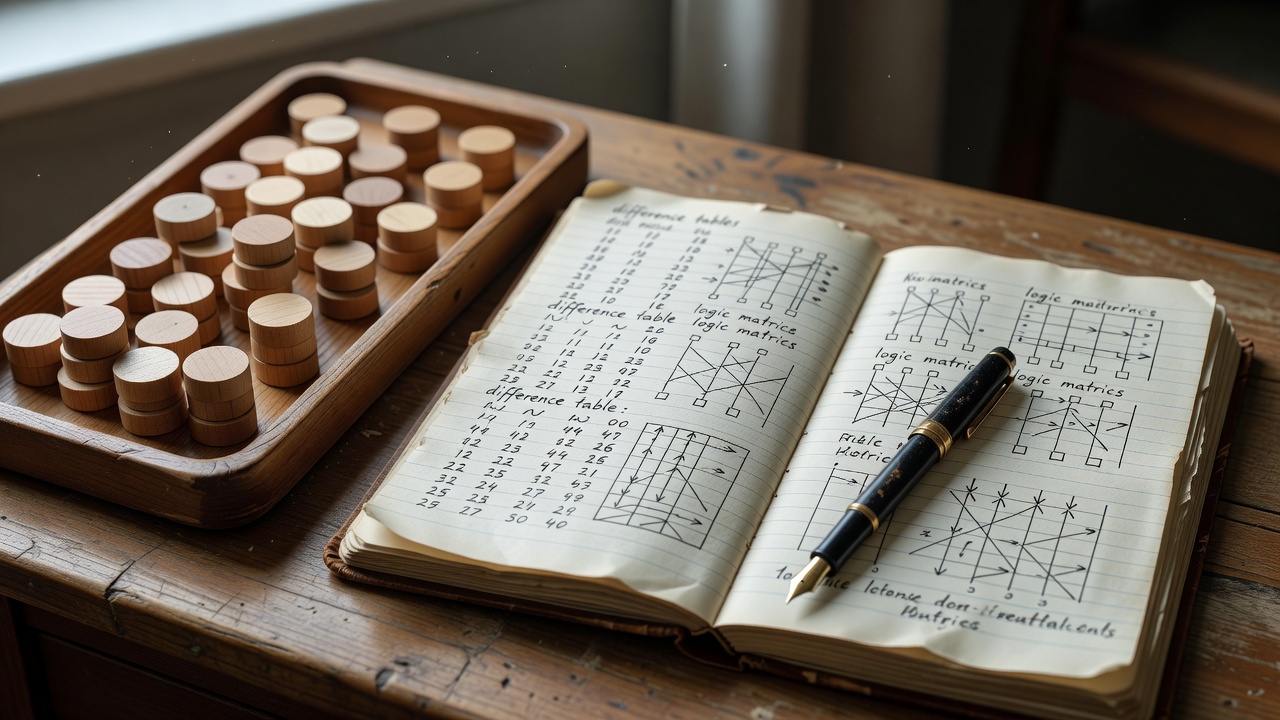
Sortotterwimb was created for adults who enjoy the quiet, methodical process of taking a tangled set of constraints and finding the exact rule that brings them into order. Across much of the web, logic and sorting activities are packaged either as frantic arcade reflexes or as quasi-medical "brain training" regimens promising sweeping neurological transformations. We take a different path: we treat sorting puzzles, sequence progressions, pattern matrices, and deductive grids as a craft of structured reasoning—worthy of the same clear explanation and historical respect given to chess endgames or mathematical recreations.
Our Three Editorial Commitments
- Precision Over Ambiguity: A puzzle is only as satisfying as its constraints are fair. Every challenge on Sortotterwimb states its governing boundaries clearly, avoids unannounced puns or cultural trivia, and verifies that a single arrangement satisfies all clues.
- Strategy Comparison Over Speed: Knowing that the answer is "46" or "Tray 2" teaches very little on its own. Our solutions compare multiple approaches—showing, for example, how an invariant parity check or a contrapositive deduction reaches the same result in three steps where trial-and-error takes twelve.
- Honesty About Cognitive Science: We respect our readers too much to make unsupported neuroplasticity claims. Working through a Ford–Johnson sorting network or a Raymond Smullyan truth table sharpens your familiarity with formal heuristics and offers deep intellectual pleasure; it does not need exaggerated marketing to justify your time.
The Lineage We Build Upon
Every topic guide on Sortotterwimb connects modern interactive challenges to the mathematicians, logicians, and designers who shaped recreational deduction: George Pólya's heuristic frameworks in How to Solve It (1945), Martin Gardner's three decades of Mathematical Games columns, Mikhail Bongard's visual contrast diagrams (1967), and Donald Knuth's exhaustive studies of sorting algorithms. By naming the underlying principles—finite differences, Latin-square distribution, boolean XOR overlays, and Modus Tollens—we give readers portable tools they can apply whenever they encounter a new puzzle family.